Tree and Shrub Care

Turn your 'Pruning Eyes' On!

(Originally posted: April 13, 2020)

So… it’s spring; a strange spring, but spring nonetheless. At a time like this when our whole world has been shaken up, it is nice to see the ‘rebirth’ that comes from soaking rains, longer days, and a higher sun.
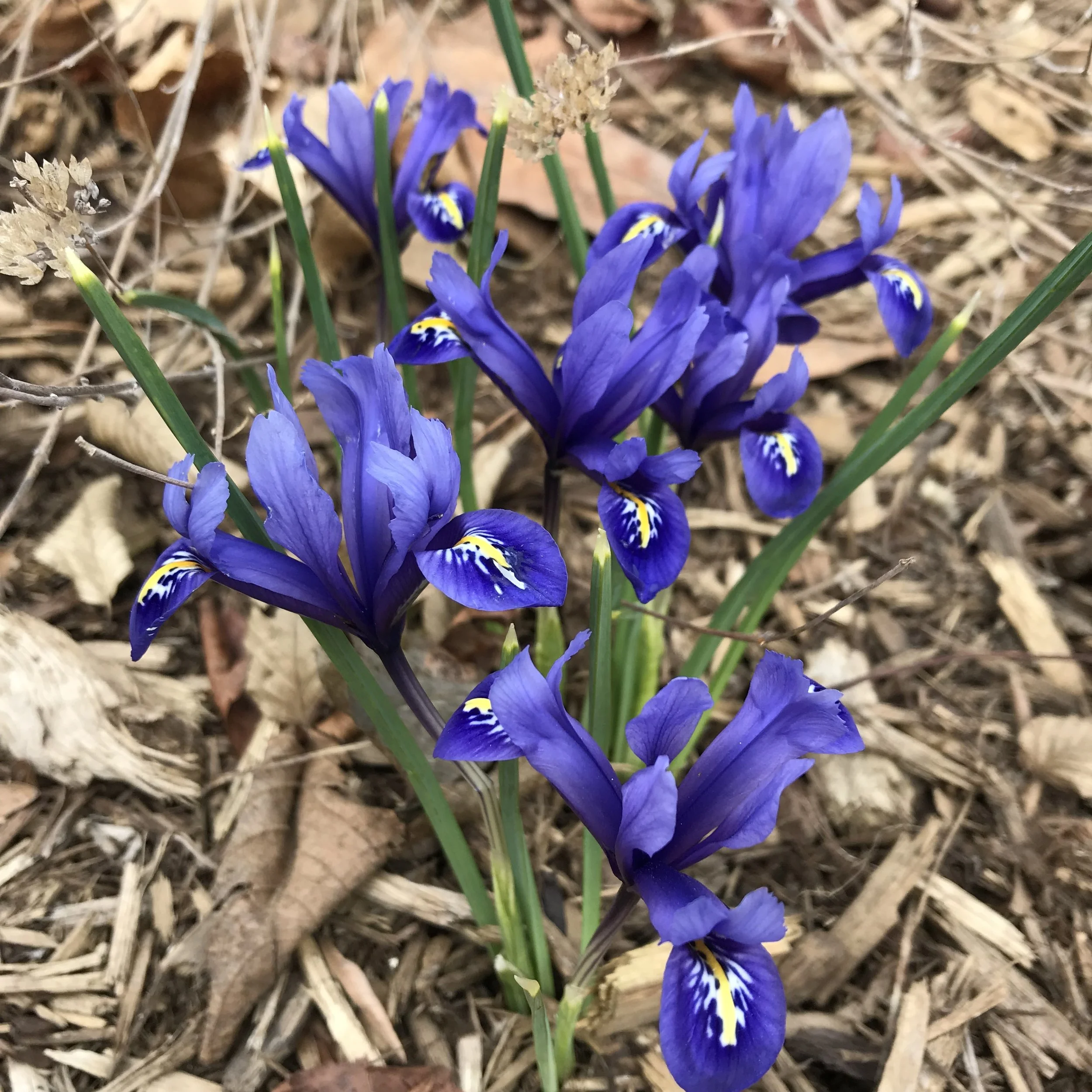
Hello little lovelies- it is so nice to see you again!

From a gardening perspective, April is typically a month that starts off slow yet builds to a flurry of activity by the end. While winter and spring play a rousing game of ‘tug-o-war’ for much of the month, I tend to focus on prepping plants for the growing season while the weather is highly changeable (first half of the month) and then conduct my detailed spring cleanups closer to the end of the month when spring is beginning to win it’s battle for seasonal supremacy. By keeping the gardens ‘tucked in’ a little longer, the plants (especially more tender ones) remain protected from any crazy weather events that Mother Nature should decide to throw at us.

(Now I will come clean and admit that I threw this timeline completely out the window in my own garden this year, because let’s face it- we are dealing with a LOT of ‘at home’ time and I am not getting my full garden fix from working in other people’s gardens!)
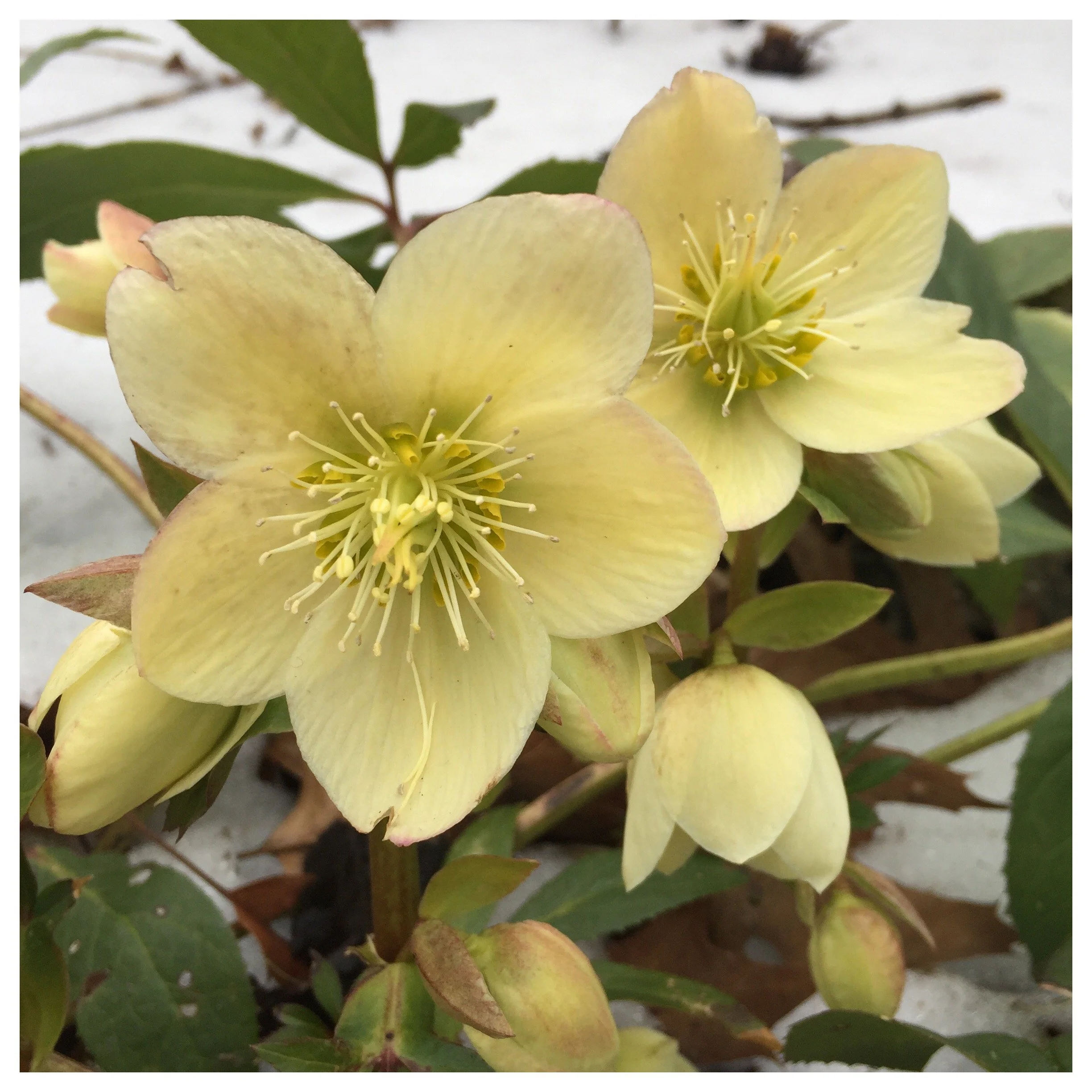
A Helleborus sp. laughing in the face of a late season snowfall.

PRUNING, PRUNING and MORE PRUNING

With all that said, in theory, my first gardening visits of the season involve A LOT of pruning (which ends up being a little hard on hands that haven’t seen the secateurs all winter…). In this post, I am going to focus on the easy stuff: herbaceous perennials and a few basic maintenance pruning techniques for woody plants.

Pruning of Herbaceous Perennials

Remember all those perennials we left up over the winter for winter-interest or for wildlife value? (See my fall post “Perennials: to chop or not?” if you need to jog your memory!) These herbaceous perennials all died to the ground or to a clump of ‘live’ leaves at the base of the plant (the basal foliage) in the fall. Well the time has come to cut all that dead stuff down while making sure to not cut off any of the basal foliage or new growth emerging from the ground. It’s an easy and gratifying task- not only does it tidy-up the garden substantially, but it often reveals new growth that is starting to push it’s way into the world. (Be sure to whisper ‘hello’!)
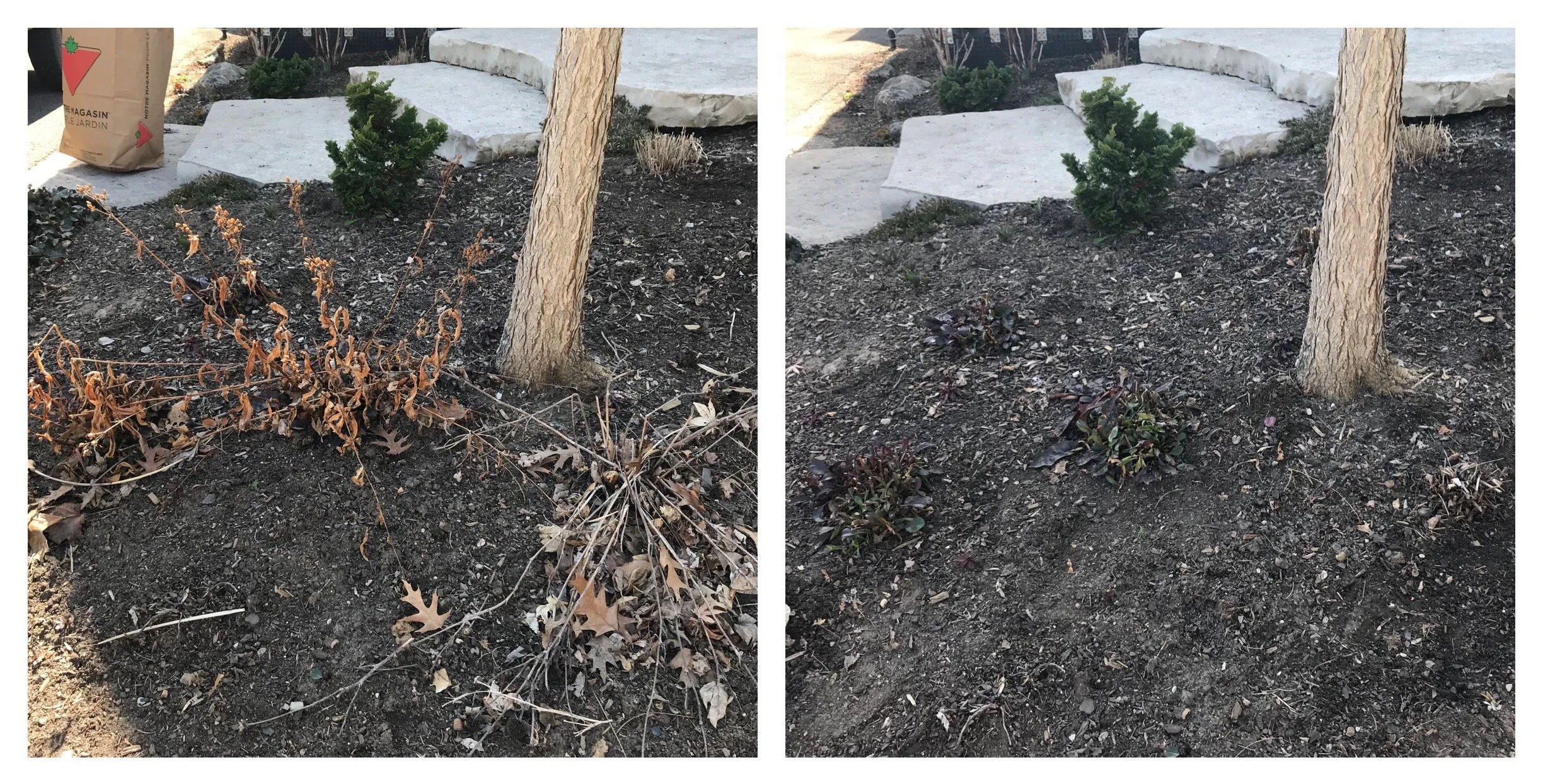
Perennials that are ready to be pruned down to make way for new growth- all the dead stuff goes!

Pruning Woody Plants- Basic Maintenance Pruning

I also do a lot of pruning on trees and shrubs, afterall it is the perfect time for pruning for a couple different reasons. First of all, and generally speaking, disease pressure is low during the dormant season and into early spring (and this is a good thing since every pruning cut we make is an opportunity for disease organisms to enter and infect our plants). Secondly we are able to actually see all the branches sans leaves- this certainly helps in identifying what branches to leave in tact and what to prune out.

As we wander through our gardens, secateurs in hand, it is important to keep in mind the types of branches that can and should be pruned out: dead, diseased and damaged branches (the three d’s), crossing branches, and finally water sprouts and suckers. Let’s looks at each of these undesirables:

DEAD branches are not only unsightly but they can attract insect and disease issues; they can also build up over time and overcrowd a shrub and therefore need to be removed.
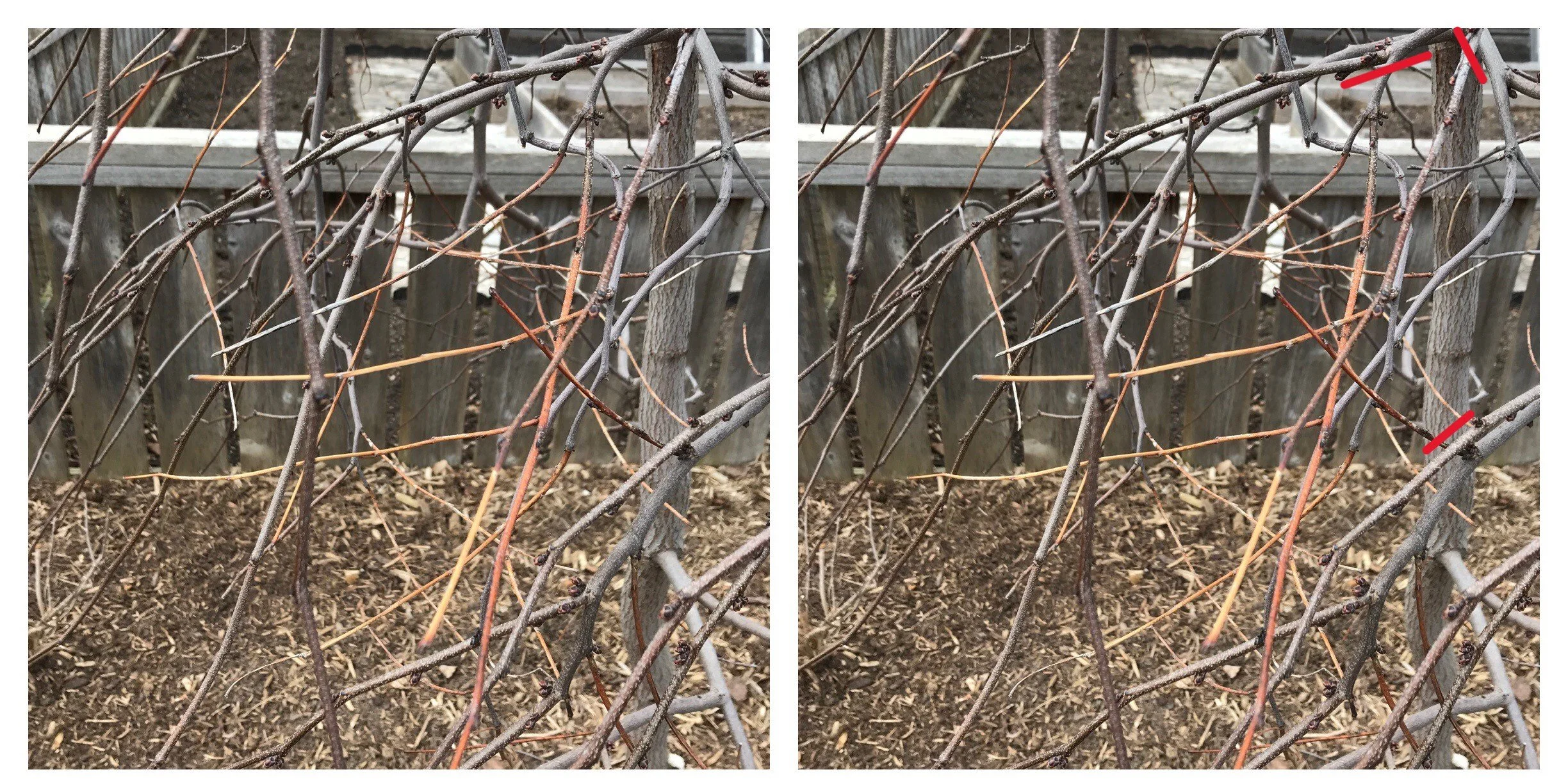
Dead branches and branches experiencing dieback on a weeping Cercis canadensis (redbud) are quite obvious due to their different colour. They need to be removed by cutting them back to a healthy branch. A few pruning points are shown in the photo on the right.

DISEASED branches should always be removed to prevent the disease from further progressing within the plant and to prevent the plant from being a source of infection to neighbouring susceptible plants (afterall, it’s hard for plants to practice social distancing).
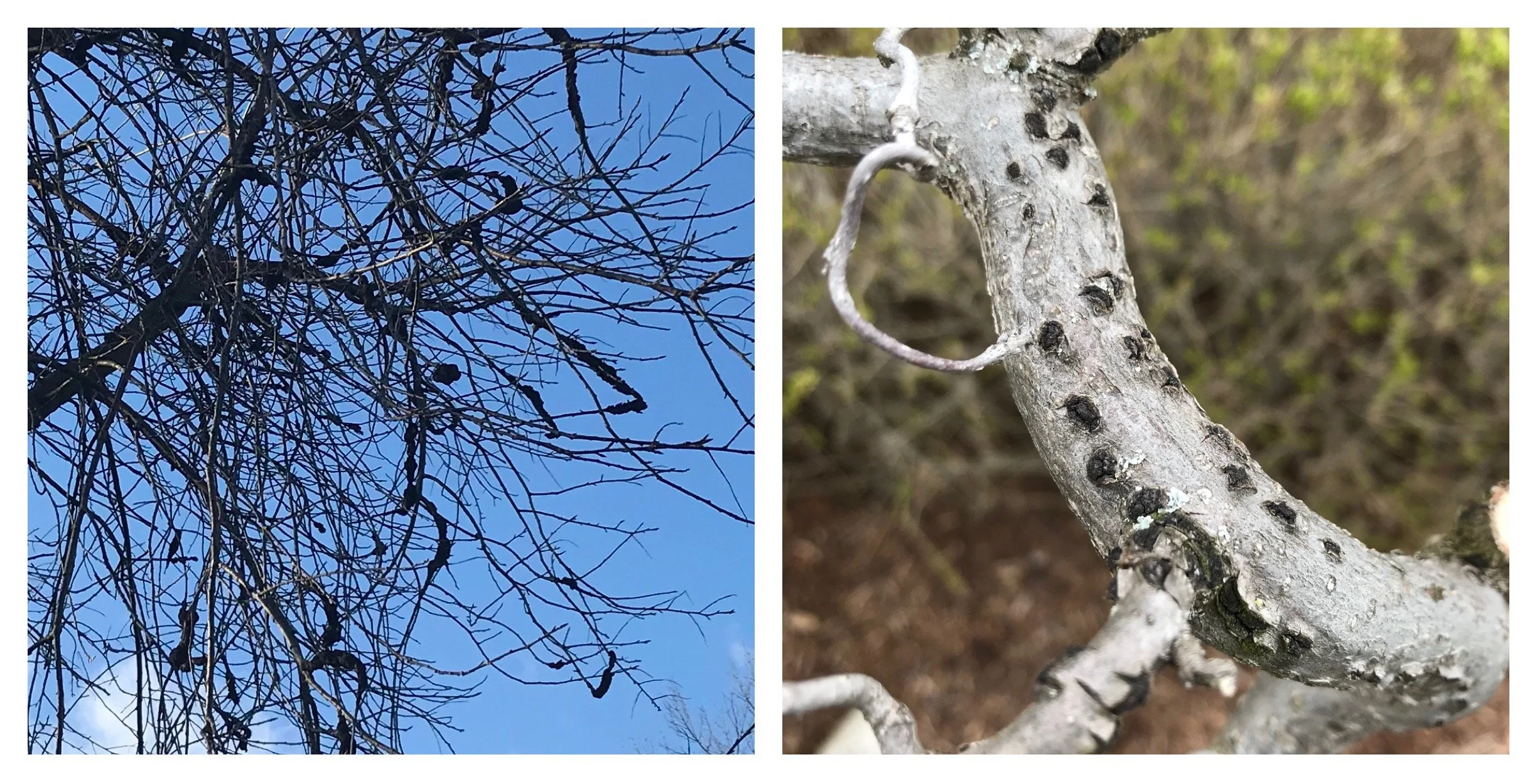
It is important to look for evidence of disease on your trees and shrubs such as the black knot galls on the chokecherry (Prunus virginiana) in the photo on the left, or the stromata/fruiting structures depicted on the corkscrew hazel (Corylus avellana ‘Contorta’) on the right. While these are two diseases that are next to impossible to control, the infected branches should still be pruned out.

DAMAGED branches (such as ones that snapped over the winter, or were nibbled-on by animals) should be pruned back to undamaged tissue. A plant can heal a clean cut much better than a jagged one!

CROSSED branches that rub against one another cause damage to both branches through abrasion. One branch (usually the smaller, weaker one) should be pruned out by following it back to where it connects with another branch and cutting it at that location.
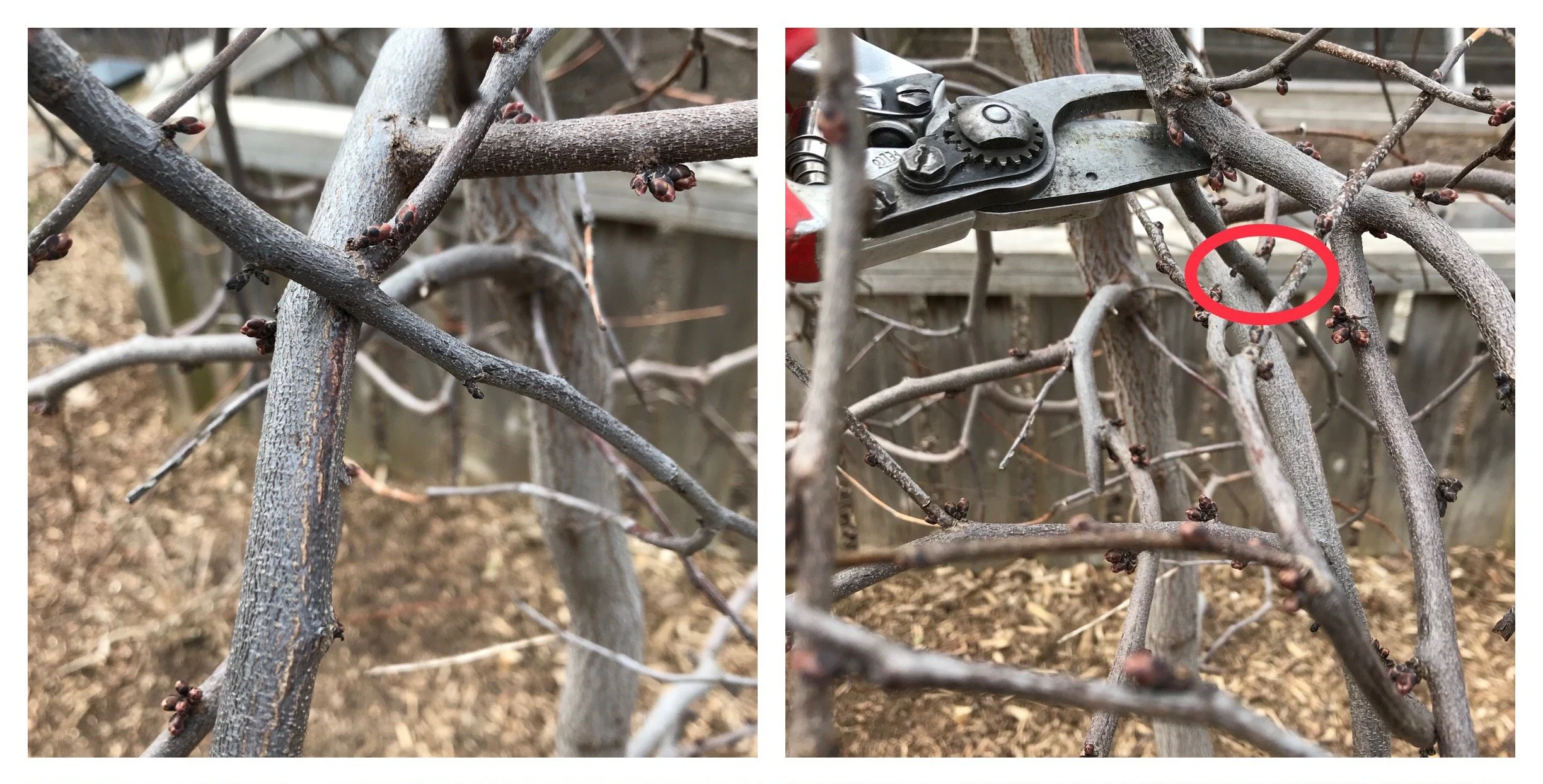
Crossed branches (left) cause damage to the branches through rubbing/abrasion. One of the branches should be removed by cutting it back to a point where it connects to another branch (right); red circle shows the location of the crossed branches.

WATER SPROUTS are really fast growing shoots that grow out of dormant buds on branches and trunks of trees and shrubs. They typically grow straight up, so they tend to stick out like a sore thumb against the normal branching habit of the plant. Their fast growth is not ‘quality’ growth- these shoots are more prone to insect and disease attack plus their attachment points to trees/shrubs are also weaker than the attachment points of ‘proper’ branches. For these reasons, water sprouts should be removed.
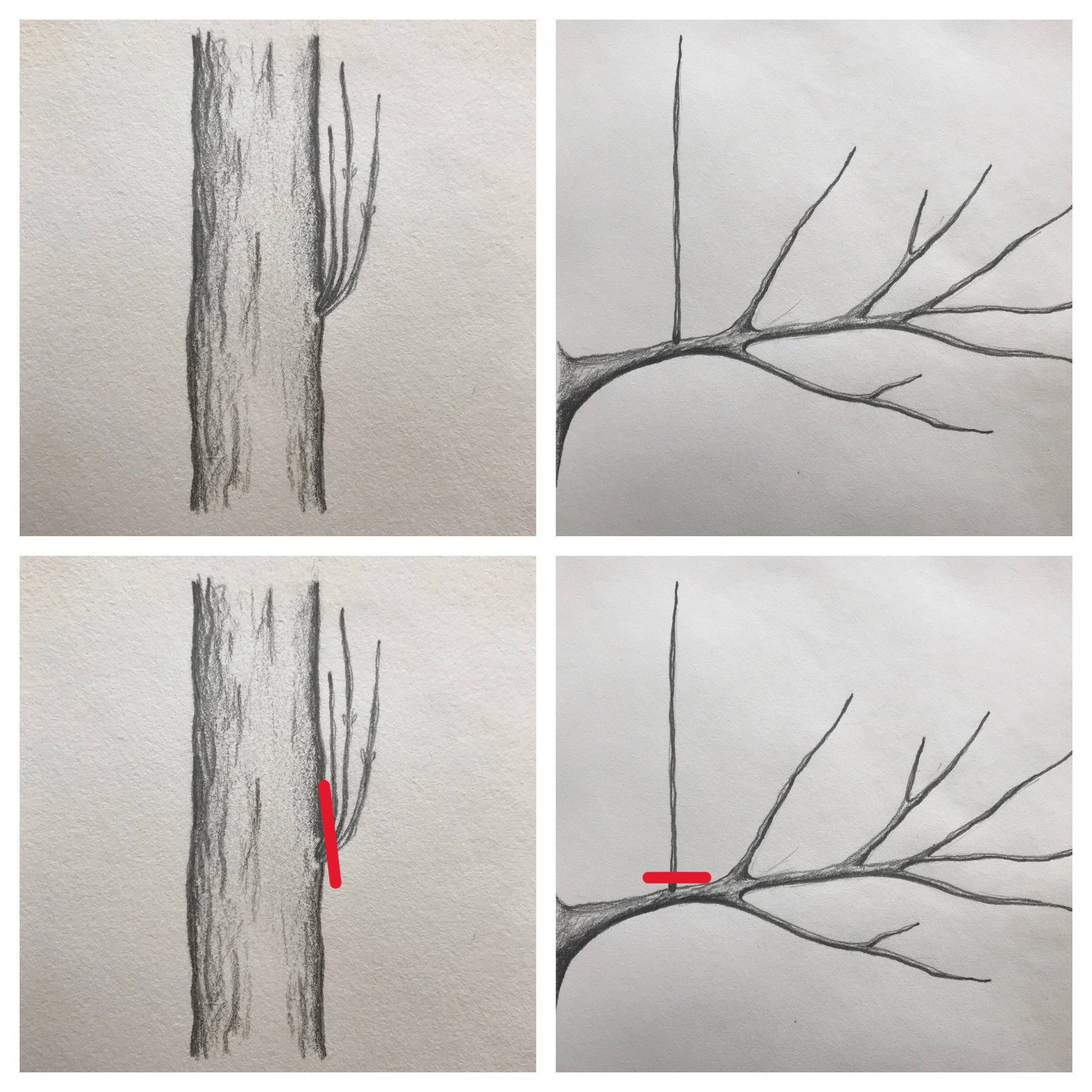
Water sprouts emerging from the trunk of a tree (top left) and from a branch (top right) and the corresponding locations of the pruning cuts to be made to eliminate the water sprouts (red lines in bottom pictures).

SUCKERS are vigorous sprouts (similar to water sprouts) that arise from the root system of a woody plant. Unless you are growing a plant for the purpose of naturalization or soil stabilization (where suckering is an acceptable, even welcomed plant characteristic), suckers should be removed with a sharp pull sideways or a snip as close to their point of origin as possible.
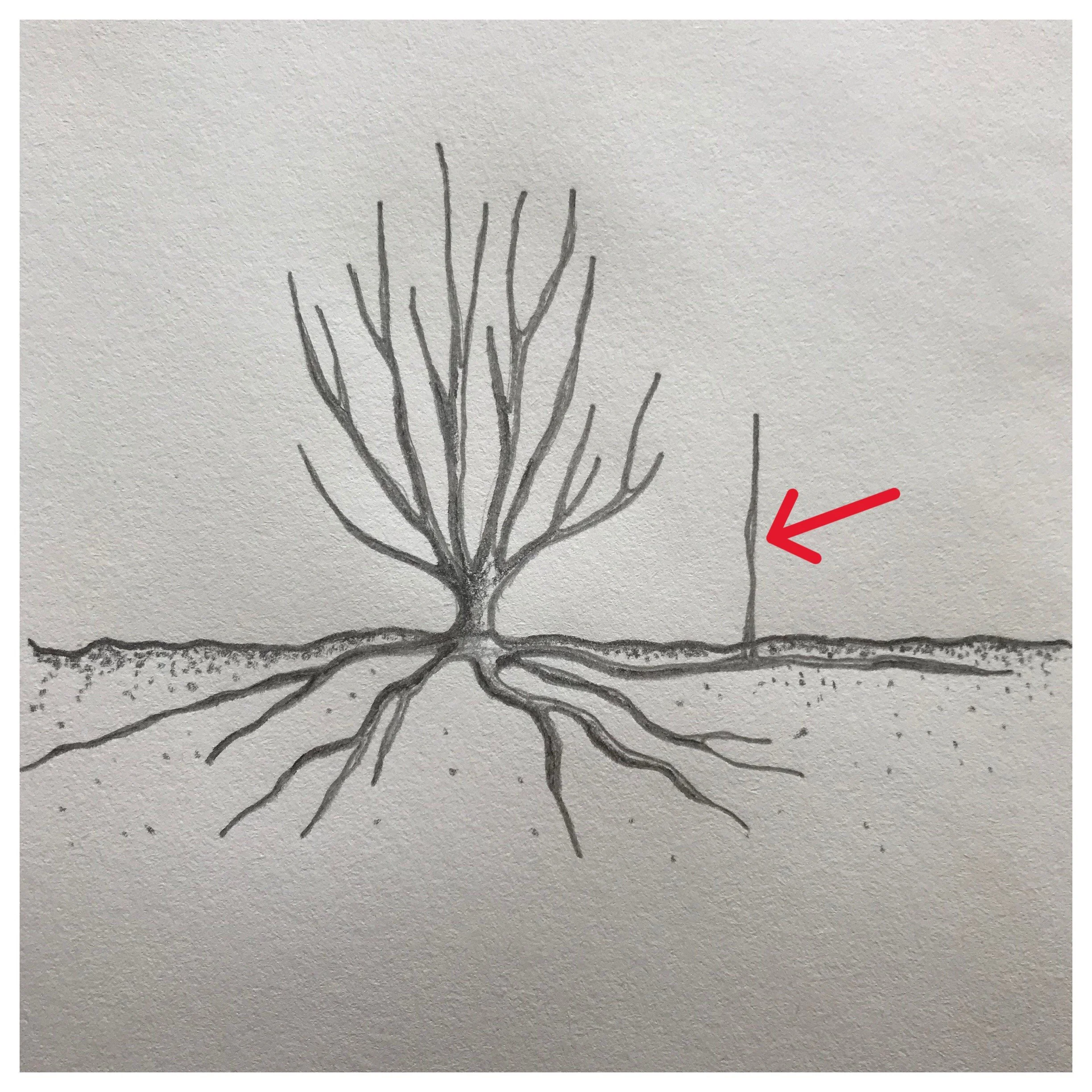
Diagram of a shrub with a sucker originating from it’s root system (as indicated by red arrow).

While our trees and shrubs are bare, it is the perfect opportunity to look for all these issues in our plants. It is important to note that we are not pruning for size reduction of our trees and shrubs (we will start this discussion in the next post) we are only removing ‘undesirable branches’ at this point.

A Few Important Pruning Tips

Before I close off this long-winded post, I want to leave you with a few things to keep in mind when pruning:

  • Always use sharp tools (again, clean cuts heal better than jagged ones)

  • Prune on a dry day: water is a great transporter of disease-causing organisms, there is no need to expose pruning wounds to potential sources of disease

  • Sanitize your pruners often! Especially after every cut into dead or diseased wood to prevent the spread of disease to other parts of the plant or to other plants in the garden. I use rubbing alcohol (applied with a bingo dabber) or disinfectant wipes

  • Always cut back into healthy wood (at least 15 centimetres/ 6 inches away from the dead/diseased tissue that you are removing) and cut back to either a bud or where the ‘offending branch’ connects to another branch.

So get your ‘pruning eyes’ on, your ‘pruning hands’ ready and get to work! Happy snipping!
Snow loads

(Originally posted: November 11, 2019)

As I write this, we are receiving the first beautiful blanket of snow for the fall/winter season- certainly putting a pause on my fall clean-ups! While there is much to say about autumn tasks and leaf clean-up, I am also going to pause these topics, and take this opportunity instead to talk about… you guessed it… snow!

(Don’t think I can’t hear your grumbles.)

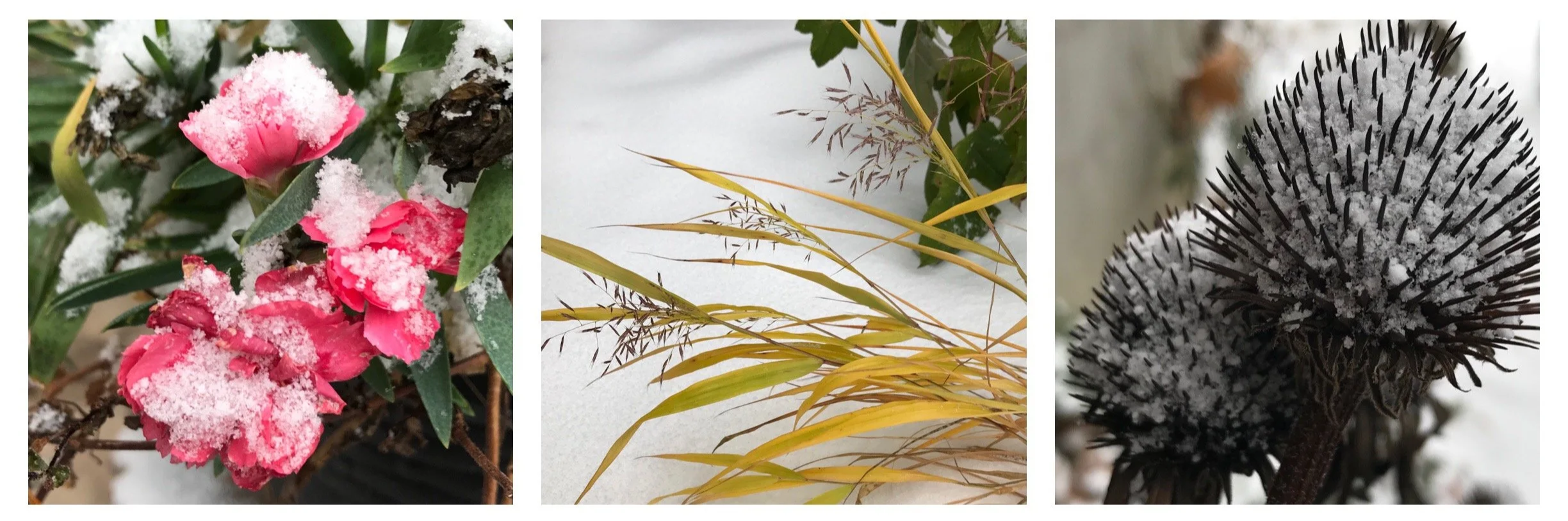
The first snowfall is always beautiful- all our ‘winter interest plants’ are fresh and looking their best…ready to shine or more accurately sparkle, with the added snow- take it in and snap some photos! It’s a magical time of year!

With that said, not all plants receive the snow with open arms- some just crumble under it’s weight. It is one thing for a perennial to flatten to the ground as a result of the weight of heavy snow (it’s OK- it will grow back from the ground in the spring), it is another thing entirely for a woody plant such a tree or shrub to be overloaded with the white stuff and snap. This is damage that the plant will need to rebound from. Aside from a potentially gaping hole in the structure of the plant, the wound is a really nice entry point for disease organisms. All this boils down to one point: we want to protect vulnerable woody plants from the damaging effects of snow loads.

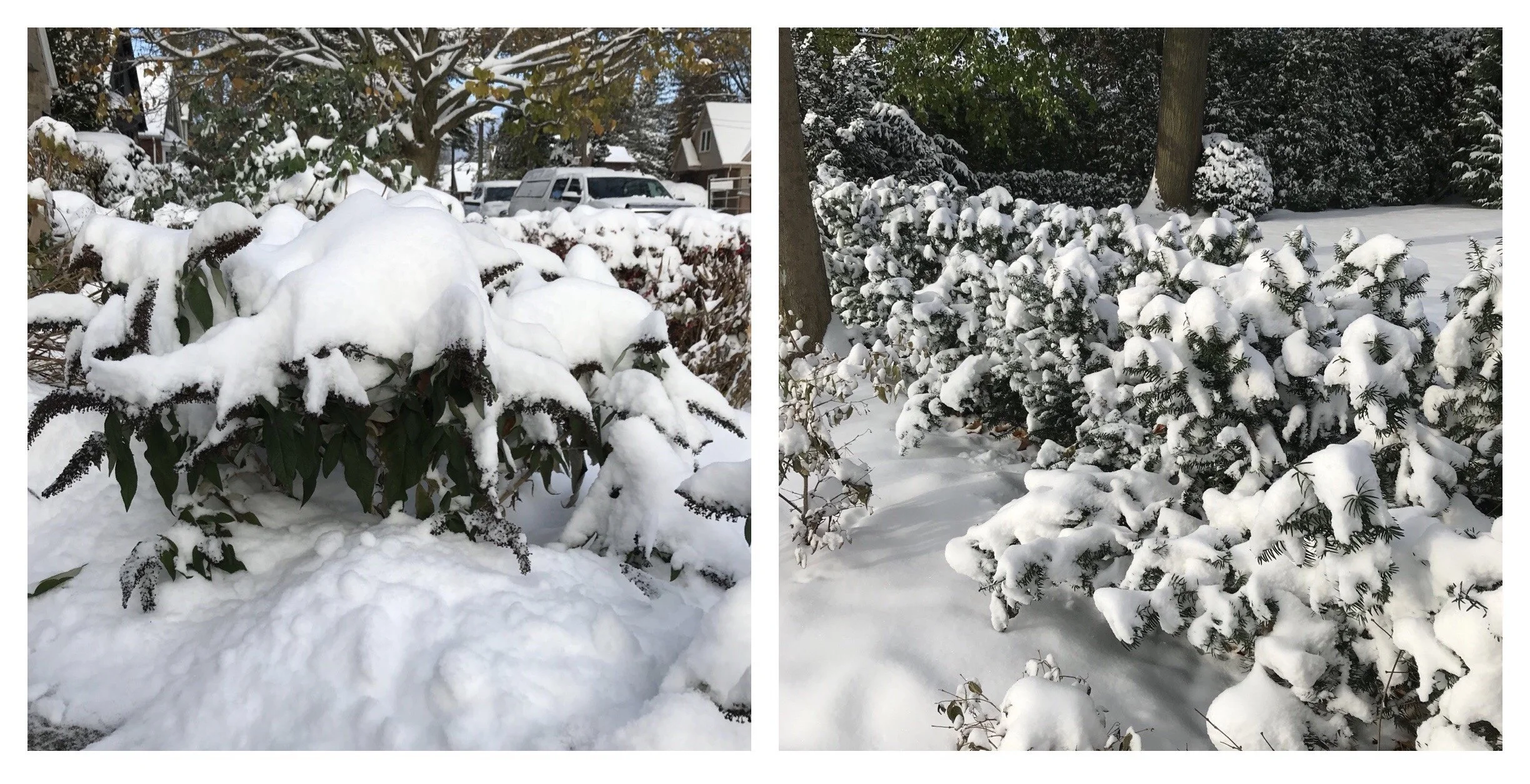
Some shrubs, like the Buddleia (butterfly bush) unphased by a blanket of snow (for now), others like the Taxus (yew) hedge on the right are not so sturdy!

Thankfully this is not a problem that affects every tree and shrub in the garden. I find that the most ‘at risk’ plants are our evergreens. Since these plants hold on to their ‘leaves’ they are also able to hold on to more snow when it falls, and their branches can’t always take that extra weight. The main evergreens that I flag as a concern are:

  • Boxwood (Buxus spp.)- when they are not routinely clipped they will lack a nice tight structure; in contrast unclipped boxwoods can actually be quite sprawly with weak branches

  • Upright-growing yews (Taxus spp.) are multi-stemmed (multiple main branches emerging from the base of the plant) and when snow piles up on them the weight can splay the stems in different directions; sometimes the stems bounce back and sometimes they don’t

  • Upright-growing cedars and junipers (Thuja spp. and Juniperus spp.) can also have multiple stems; if they do, these plants will have similar problems to the yews mentioned above.

The main goal of protecting against snow is to provide some supplemental support to the plant to prevent the branches from snapping or the multiple stems from splaying. This can be accomplished in three ways:

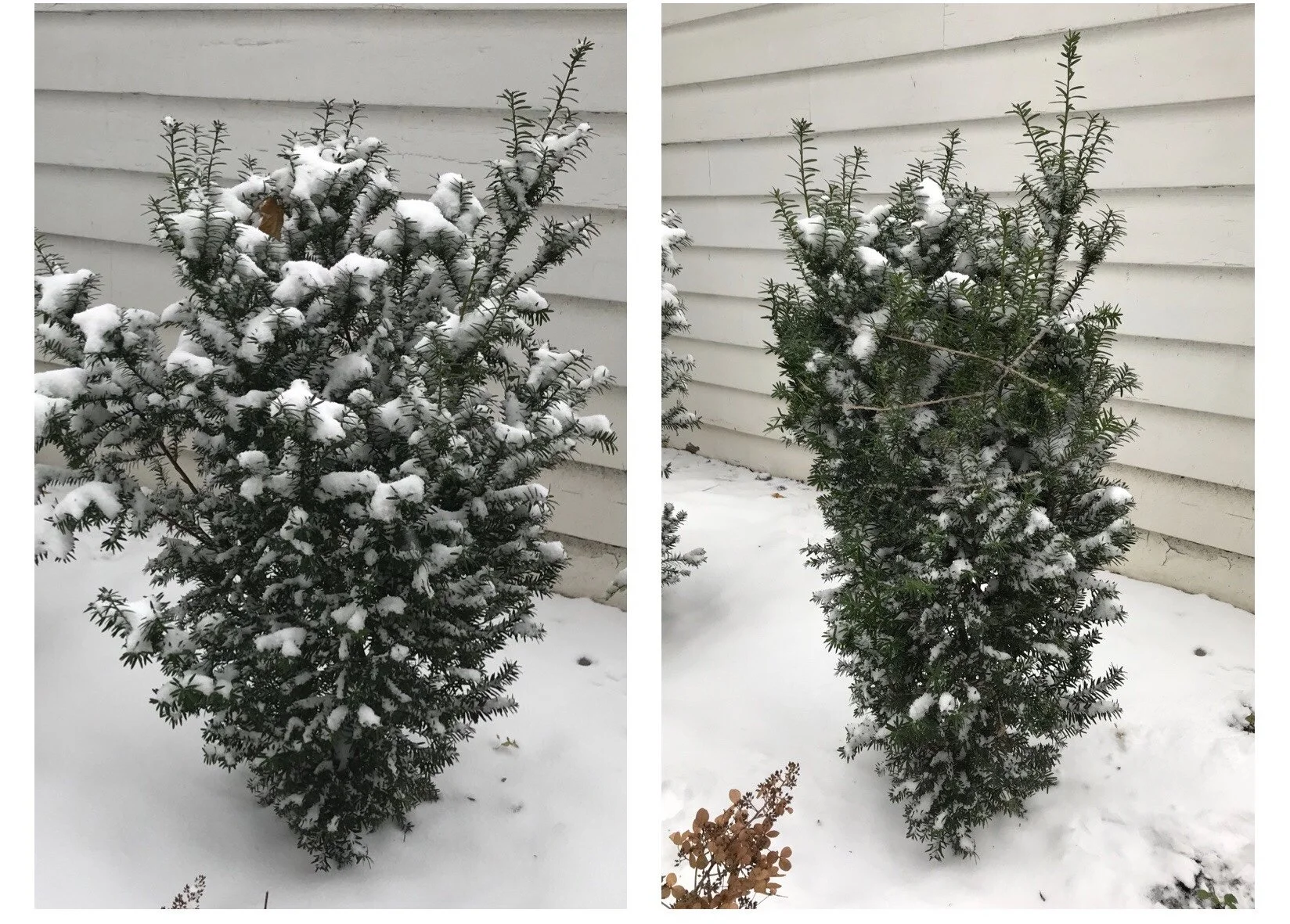
1) Tying up the branches/stems of the plant together so that the branches are able to support one another and there is a reduced area on which the snow can land. To accomplish this, I tie twine to a branch close to the top of the plant, spiral it around the tree/shrub to the bottom and then work my way back up. I pull the branches in toward each other slightly to ensure they are getting some support however I still want the branches to have air flow to prevent disease problems so I don’t pull the branches in too tightly. This twine gets removed in the spring.

2) Erecting a structure that can act as a support when the plant needs it. This approach can be as simple as a small makeshift fence that prevents branches from bending over too far. This tactic works for smaller shrubs.

3) Commit to being on ‘snow patrol’. If you think you have plants that may suffer under the weight of a good dumping of snow (but you live in an area where this is an exception and not the norm), you can always periodically trek outside during a storm and gently brush the snow off the plant to free it from the load. (Who says you can’t garden in the winter?). This is also a great tactic to use when you get caught off-guard with an early season snowstorm!

And there you have it- your first ‘taste’ of winter! We will resume the regularly scheduled ‘fall programming’ with the next post. Hot chocolate, here I come!

YUM. (Photo created by freepik - https://www.freepik.com/free-photos-vectors/christmas)

Temper your Enthusiasm

(Originally posted September 15, 2019)

The crisp nights and cooler days have arrived- a sure sign that fall is around the corner. Fall is generally a time of yard work and many people become very enthusiastic to tackle outdoor chores- even people with no interest in their yard whatsoever throughout the rest of the year tend to catch the ‘gardening bug’ during the autumn months. Often this enthusiasm is directed at whacking back various trees and shrubs in their yard. While there is certainly lots to do before the snow flies, pruning is the one task that we want to minimize at this time of year. (Sorry Edward Scissorhands wannabes!)

Let’s start with the effect that pruning has on a tree or shrub… it promotes new growth. New growth is tender and needs time to toughen up to the environmental conditions around it. At this time of year, our frosty mornings are just around the corner. If we prune now, new growth that emerges will not have the time to properly harden off before the cold weather hits, which can ultimately lead to death of the new plant tissue… therefore you will get dieback. On deciduous trees and shrubs (ones that lose their leaves for the winter), this dieback would be apparent in the spring; on evergreens it could become obvious during the fall and winter months. Dead new growth is not the nicest thing to look at on a plant that is supposed to stay green for the winter!

Furthermore, plants are using this time to start shutting themselves down for the winter. They are gathering sugars and carbohydrates from their leaves and storing them in their stems, trunks and root systems; valuable energy to help the plant survive the winter and flush out new growth in the spring. Removing the leaves before they fall doesn’t allow the plant to relocate these sugars to their ‘winter storage facilities’ and therefore the plant is robbed of it’s energy sources for the months ahead. Additionally, the stimulation of new growth through pruning counters what the plant is trying to do. Instead of putting energy towards properly ‘shutting down’ it is putting energy towards new growth; this can weaken the plant going into the winter.

While it is true that plants can rebound from a late season prune, it is not an ideal time for this gardening task.

So… if you feel the call of the pruning saw, hedge shear or lopper- ignore it! Opt to warm up some apple cider, mosey through the garden, and start your ‘to do list’ for next year. Those shrubs and trees that you are just dying to hack back now will still be there in the spring and they can be first on your ‘hit list’ for a dormant season prune come a mild day in March***! Not to mention, with all that energy [properly] saved-up for a spring flush, the plant will be able to quickly rebound from your ‘haircut’.

Can you hear that?

That is the sound of your shrubs and trees breathing a huge sigh of relief.


***While any plant can be pruned in the dormant season, it is important to note that if you prune anything that flowers early in the growing season, you would most likely be removing flower buds. For these plants it means that a hard prune = no flowers for the upcoming growing season. While some people may gasp in horror at the thought of this, sometimes it is a necessary evil in order to renovate an overgrown shrub. More on pruning and timing of pruning in future posts… I promise!

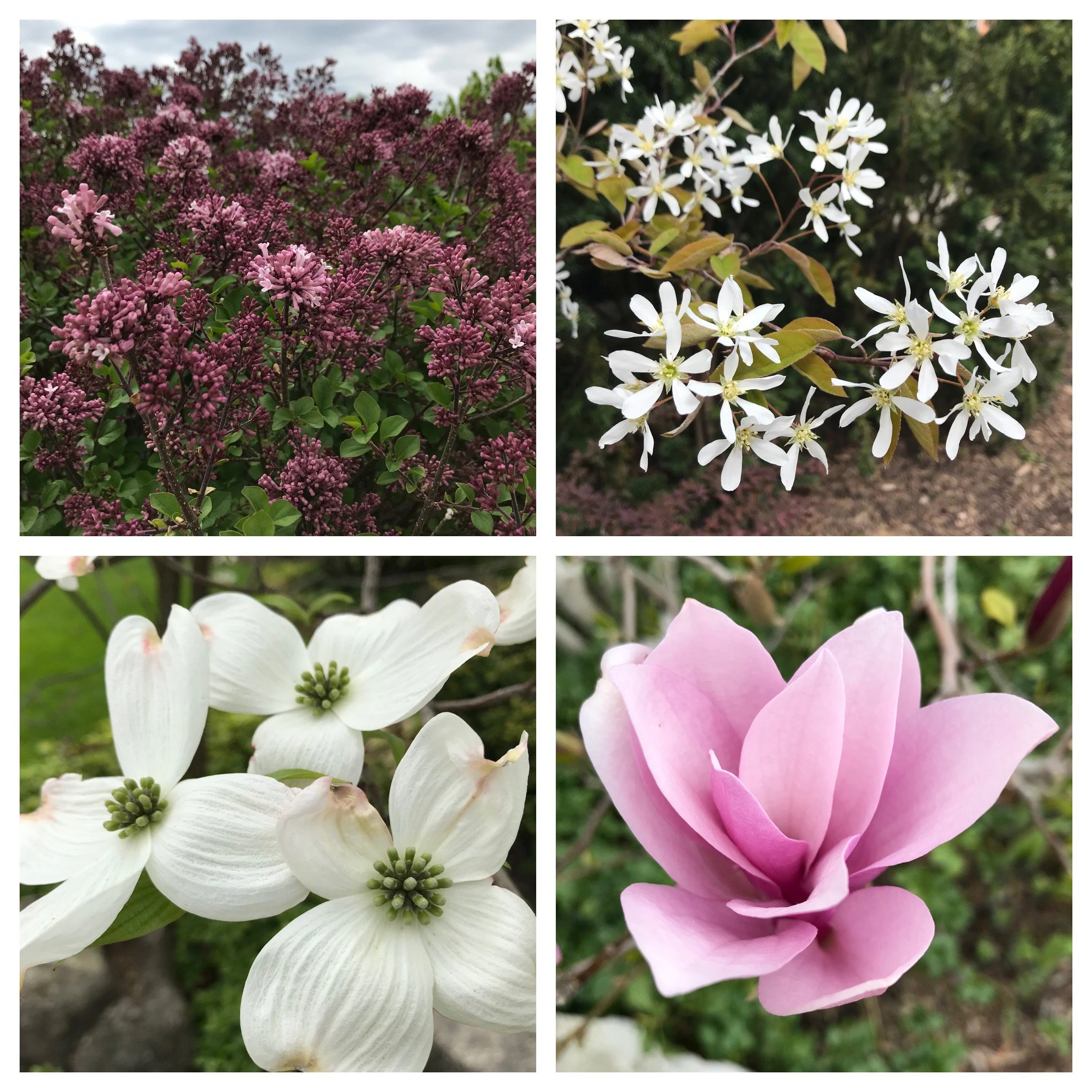
Remember these early season beauties? A prune at this point in the year (or any time leading up to their flowering period) would remove their flower buds. Believe it or not, plants such as these are already prepared for their 2020 show!

Clockwise from top left: lilac (Syringa sp.), serviceberry (Amelanchier sp.) magnolia (Magnolia sp.), Dogwood (Cornus sp.)